
Written by: Robert Rosenfeld, DDS
INTRODUCTION
Since its introduction in 2019, OMNICHROMA (Tokuyama Dental America) has set the standard for so-called “single-shade” composites. Its supranano-sized spherical filler particles allow it to transmit light in the yellow to red part of the visible spectrum. That enables the material, which looks white and opaque before curing, to beautifully match the full range of VITA Classic shades (and sometimes beyond) when cured.
The material is available as a conventional paste composite, a flowable version, and a bulk fill version (Flow BULK) that is more fluid and cures to a depth of 3.5mm. For restorations that need it (eg, dark stained dentin or an anterior Class IV) a more opaque Blocker is available in regular or flowable versions. The following case demonstrates the use of OMNICHROMA composites to restore a challenging quadrant of carious lesions.
Case Study
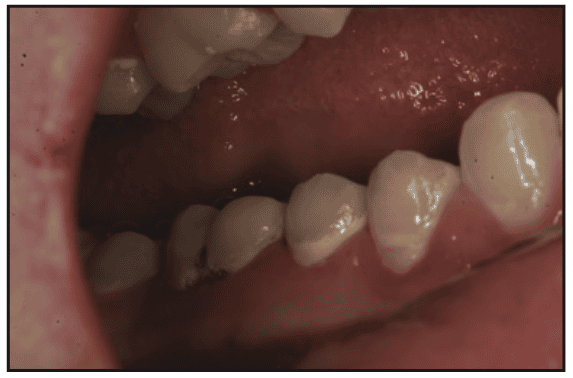
This 16-year-old female first presented in 2023 with poor hygiene and rampant decay. A few restorations were performed, but the patient was terribly anxious and didn’t return for further treatment for over two years. As her 2026 pretreatment photo (Figure 1) shows, there was significant buccal cervical decay on teeth Nos. 29 to 31. Additionally, there were small interproximal lesions on the distal of No. 28 and the mesials of Nos. 29 and 30, and very deep lesions on the distal of No. 29 and the occlusal of No. 31. The approximate shade of her teeth was VITA A2.
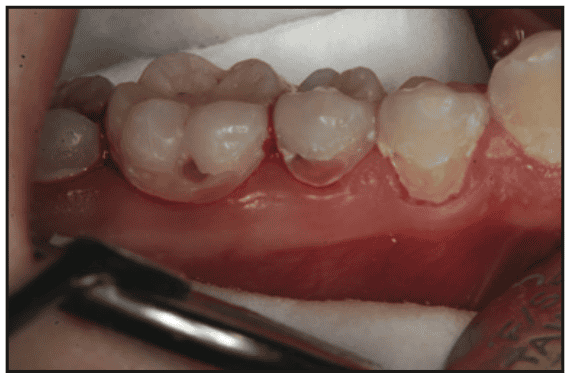
After administering anesthesia, I set out to treat the “smaller” lesions, leaving the largest two for last. That way, if root canal therapy were to become necessary, the teeth would be more readily isolated. I excavated all three Class V lesions (Figure 2).
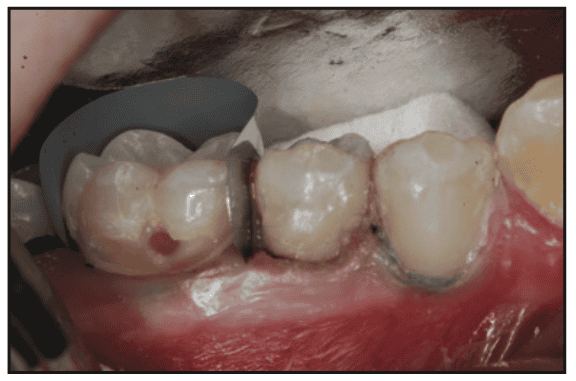
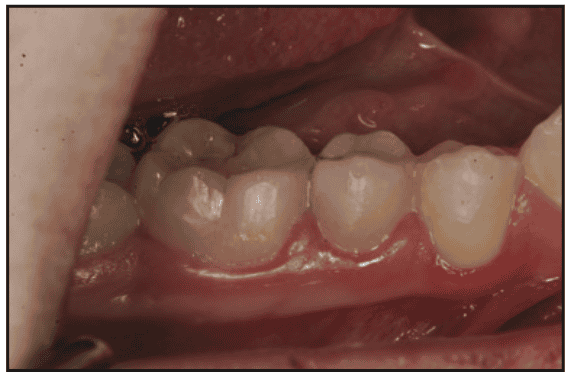
I obtained retraction and isolation by placing retraction cord (Ultrapak [Ultradent]) dipped in viscous aluminum chloride (ViscoStat [Ultradent]). I prevented the restorations from bonding the adjacent teeth together by using a piece of matrix band to separate them (Figure 3). Next, I sequentially restored all 3 by selectively etching the enamel with phosphoric acid, placing adhesive (Clearfil SE Protect [Kuraray America]), and then placing a bit of OMNICHROMA Flow followed by OMNICHROMA, and curing them together in the so-called “snowplow” technique. The finished and polished restorations are shown in Figure 4.
Next, I proceeded to restore the Class II interproximal lesions. I prepared the back-to-back lesions on No. 28 distal and No. 29 mesial and restored them simultaneously using Garrison Dental’s Quad Matrix system (Figure 5). I similarly restored the mesial-occlusal of No. 30. All were restored by placing an initial layer of OMNICHROMA Flow, followed by OMNICHROMA. Figure 6 shows the completed restorations. After all of this, the patient became a little overwhelmed and chose to return for treatment of the two larger lesions.
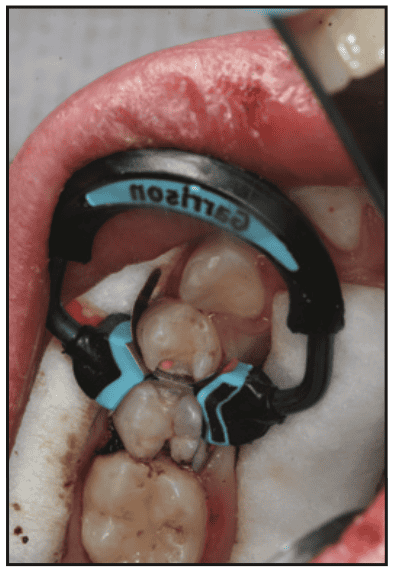

At the subsequent visit, with the very real possibility of carious exposures, I employed rubber dam isolation. I deeply excavated the distal of No. 29, which yielded a pinpoint carious exposure. I explained that root canal therapy would be appropriate, but proceeded to restore the tooth to simplify isolation for the endodontist.
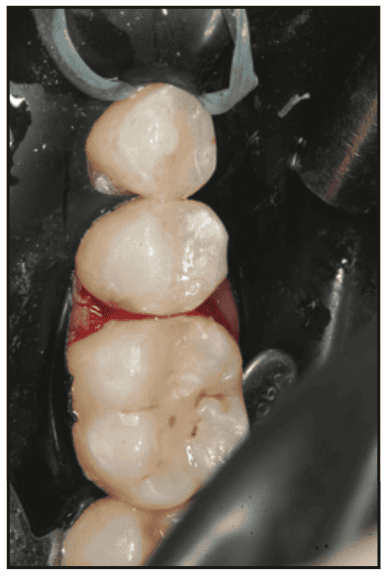
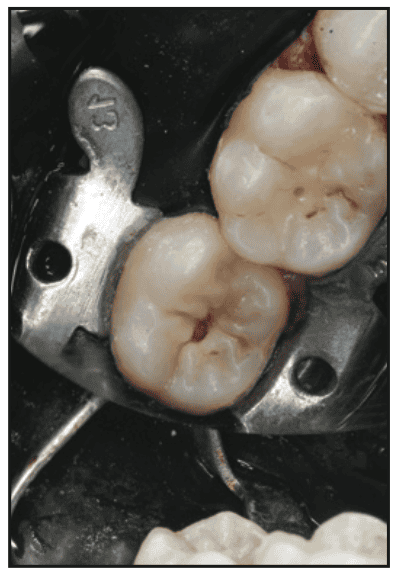
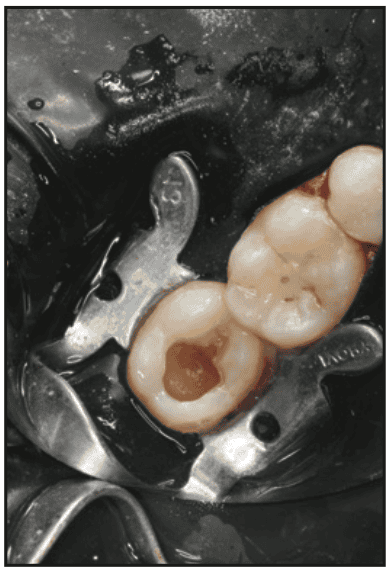
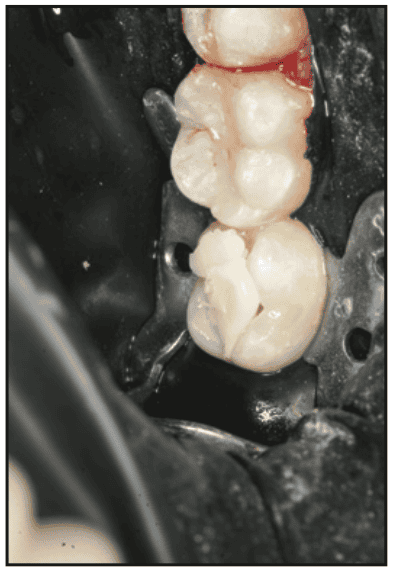
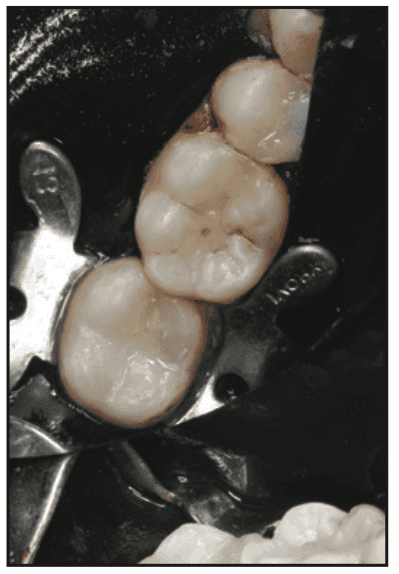
Using the Garrison matrix system once again, I first placed a layer of Theracal (BISCO) for pulpal protection (Figure 7). This was followed by selective etch, adhesive, an initial layer of OMNICHROMA Flow BULK (for optimal adaptation) and then OMNICHROMA (Figure 8). Lastly, I addressed the deep occlusal lesion on tooth No. 31 (Figures 9 to 10). I restored it with Theracal, OMNICHROMA Flow BULK, and then OMNICHROMA. Figure 11 shows just how opaque the material looks out of the syringe, but the cured restoration (Figure 12) shows how beautifully the material matches its surroundings.

This case shows how, in each of these restorations and applications, all teeth can be matched with a single-shade material. Combined with its high polishability and durability, the use of the OMNICHROMA family of composites eliminates the shade selection process, making it unnecessary to stock dozens of shades of material.
For more information, call (760) 942-7211 or visit tokuyama-us.com.

