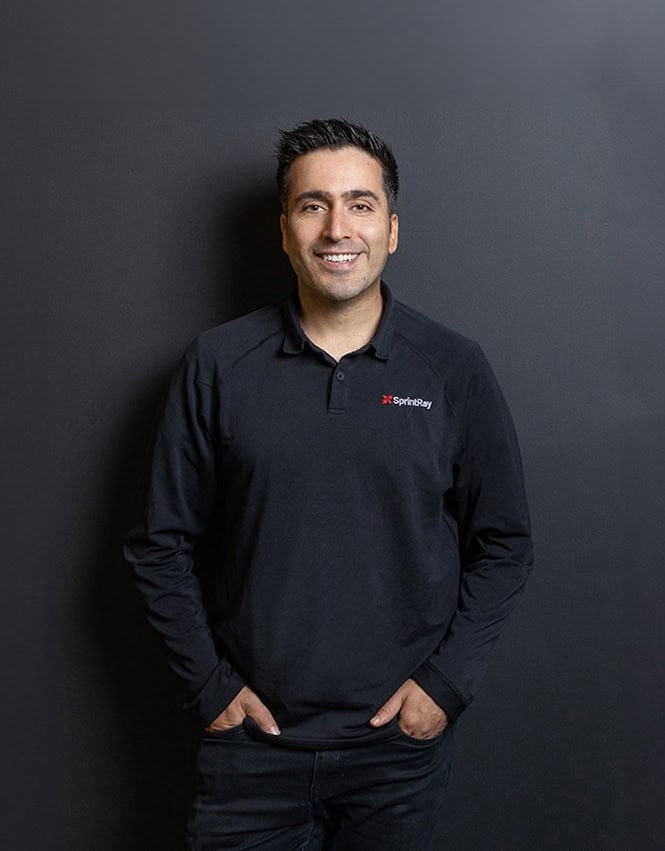
Written by: Amir Mansouri, PhD, co-founder and CEO, SprintRay
When I first started working on 3D printing with my co-founders, I had no idea it would lead me to dentistry. Back then, we were research PhD students at the University of Southern California experimenting with 3D printing for many different projects. The most exciting one was 3D printing on the surface of the Moon, sponsored by NASA. We were fascinated by how a single technology could bring ideas to life. We didn’t know it at the time, but that same curiosity would later change how people experience dental care.
In most industries, efficiency comes from mass production. Cars, clothing, and electronics are built to serve many. Dentistry is different. Every patient’s mouth is unique; every restoration is made for one person. That makes dentistry one of the industries best suited for 3D printing and mass customization.
Now we’re seeing breakthroughs across the field, from new materials and AI design tools to methods that help preserve more of the natural tooth. In this article, I explore 5 trends that are reshaping the future of dentistry.
1. The Rise of Same-Day Care
Our lives are busier than ever. Attention is spread thin, time is scarce, and people’s patience is even more so. People no longer want to wait or return for multiple appointments. They want fewer doctor visits and their procedure done in a single appointment. They don’t want to have to return a second time for a night guard or a crown.
Love it or hate it, this is what most patients want. It may be less convenient for providers, who now have to fit fabrication into a 2-hour appointment, but that’s what innovation demands. Every business must evolve with its customers’ expectations—or risk losing them.
The move from lab-made restorations to in-office production has been one of the biggest shifts in modern dentistry. In the past, patients would wait weeks while impressions were shipped to a lab, models were cast, and crowns or dentures were milled and mailed back. Now, that entire process happens chairside in less than 30 minutes. A crown, inlay, onlay, flipper, or night guard can be scanned, designed, 3D printed, and placed in a single visit.
Same-day dentistry changes everything about the experience. It saves time for patients, helps clinicians treat more people, and reduces costs for both, turning what used to be a complicated process into something that feels simple and seamless. A patient can walk in with damaged teeth and leave the same day with a restored smile.
You might say that chairside CEREC has been the topic for 20 years and never achieved more than 20% adoption, so what’s different now? Well, a lot of things. Chairside 3D printing is far easier to use, more affordable to start, and far more versatile. You essentially have the entire lab at your fingertips. With companies such as SprintRay and others making the experience of dental 3D printing feel like consumer electronics, you don’t have to figure everything out yourself. You can do more in less time, accomplishing exactly what you have to do for your patients in a single appointment. You can now design, print, and post-cure a definitive crown in less than 30 minutes.
2. Intraoral Scanning is a MUST
If you don’t have a scanner and are still trimming alginate and making PVS impressions, the time has long since come to re-evaluate. In the US, about 60% of clinicians have adopted intraoral scanning—meaning 40% surprisingly have not.
This baffles me. An intraoral scanner is a no-brainer from a technology perspective, not to mention a massive experience booster for patients. There is absolutely no reason in this day and age to make cast impressions and send physical models to a lab.
Not using an intraoral scanner is the equivalent of dentists who use analog film x-rays instead of digital. There is simply no business case not to evolve. Align Technology (iTero), Medit, and 3Shape are among the leaders in this category.
3. The Rise of AI Design
As much as we all talk about AI, few have clear guidance on how to use it in dental practices beyond using ChatGPT to write emails. Here’s how AI is already making a real difference:
Diagnostics: AI is helping dentists detect cavities and caries more accurately in x-rays and CBCT scans. Many systems now include built-in AI models that serve as a valuable second opinion—it’s amazing how much better it helps you detect. There has always been the perception that dentists over-diagnose procedures, but surveys show that doctors who adopted AI diagnostics are actually under-detecting. Adopt it today.
AI Design of Dental Appliances: Once you start doing your own appliances in-house, you need a way to design your night guards or crowns. This is where AI design tools come in handy. Pre-AI, you had to buy expensive software, pay annual licenses, spend time learning the software, and then spend even more time designing cases every day. Everything has changed now. There are great AI models out there that do 95% of the job for you, and you only need a few clicks to finish it. 3Shape Automate, exocad, and SprintRay are among the most prominent companies in this category.
AI Agents as Practice Efficiency Tools: The true use of AI beyond using ChatGPT is using AI agents. AI agents are instructed to make decisions on your behalf and automate the tasks we used to rely on staff for. For example, we used to have staff whose job was to schedule training calls with our customers. Now we have AI scheduling agents that reach out to customers via text, email, or phone until scheduling is complete. Or we used to have staff whose job was to call customers and introduce our new products. Now we have AI agents that mine our existing customer data and are ready to introduce new products and even sell them.
You can do the same thing. You can place an AI chat agent in your portal to convert web visitors to appointments or use an AI agent to answer social media leads and turn them into appointments or place an AI system to mine your existing data and reach out for cleaning, orthodontics, or night guard appointments. Don’t wait—get started. This is what drives and motivates me to implement these tools: if my competitors do it before me, it becomes incredibly hard to compete with a company that has an army of AI agents running in the background. I want to be first. The same thing applies to you and your business.
4. Restoring While Preserving
Let’s accept this: for decades, restorative dentistry meant removing healthy parts of the tooth to make room for a crown or filling. Cheap zirconia restorations, the convenience of just grinding and putting a rock into someone’s mouth that never breaks, and the fact that you don’t have to see the patient again, all made zirconia a standard and prevalent solution in dentistry. But the same logic I shared in the rise of same-day dentistry applies here—it’s convenient for you, but it’s not necessarily the best for your patient.
I don’t want to get into the clinical reasons why zirconia destroys the opposing dentition. Still, from a healthy-tooth preservation standpoint, we are seeing a major shift in mindset among younger dentists entering the field. And believe me, once this newer generation takes over, it becomes super hard to compete if you stay stuck in the old way. That approach worked, but it came with a trade-off. Today, with more precise scanning, smarter design tools, and more natural materials, we can take a much more conservative approach to care.
That shift changes everything. When you can restore with accuracy and minimal intervention, patients trust the process more. They feel the difference right away. The bite feels more natural, adhering to the tooth and supported by biocompatible, bacteria-resistant materials designed to work naturally within the human mouth. Technology fades into the background, and what remains is better care and longer-lasting restorations.
5. Making Dental Care More Affordable and Accessible
Last, but not least, is the way 3D printing new materials and AI are democratizing dental care. Technology is closing the care gap in ways that were simply not possible before. The same systems used in major cities are now reaching smaller clinics and underserved communities around the world.
With portable printers and simplified workflows, the level of precision you expect in a Beverly Hills practice can now be delivered in a small clinic in Jamaica or Tanzania. These tools are no longer limited to large offices with big budgets. They are becoming accessible, affordable, and practical for anyone.
Digital workflows with 3D printing are also redefining how teams work together. Dentists, labs, and educators can share cases and results instantly. A doctor in LA can collaborate with a dentist across the world, compare outcomes, and improve the next restoration based on real feedback. That kind of knowledge sharing barely existed before.
This new way of working is creating opportunities for collaboration that did not exist just a few years ago. And even with all this progress, it still feels like we are only now scratching the surface of what’s possible.
ABOUT THE AUTHOR
Dr. Mansouri is a Los Angeles-based entrepreneur and the CEO and co-founder of SprintRay, a leading company in digital dentistry. Under his leadership, SprintRay was named as one of the top 5 on Fast Company’s Most Innovative Companies in MedTech and has revolutionized same-day dental care through 3D printing. He holds a PhD in engineering from the University of Southern California, was named an E&Y Entrepreneur of the Year in 2025, and was recognized as one of the Top 30 Most Influential People in Dentistry in 2024 and 2025. Additionally, Dr. Mansouri serves on the Innovation Board of Advisors for Harvard School of Dental Medicine and High Point University. He can be reached at [email protected].
Disclosure: Dr. Mansouri is the co-founder and CEO of SprintRay. He has no financial interest in any of the other companies mentioned in this article and received no compensation for writing this article.