INTRODUCTION
Successful root canal therapy requires a thorough knowledge of both the external and internal anatomy of root and its canal morphology. Extra roots or root canals, if not detected, are a major reason for endodontic failure.1 Maxillary molars show considerable anatomic variation and abnormalities with respect to the number of roots and root canals. Traditionally, the maxillary second molar has been described to have 3 roots with 3 or 4 root canals, with the fourth canal commonly being found in the mesiobuccal root (MB2). Pécora et al2 investigated the internal anatomy of 370 cleared maxillary molars and observed that the first, second, and third molars presented 3 canals, each corresponding to individual roots in 75%, 58%, and 68% of cases, respectively, whereas 4 canals were present in 25%, 42%, and 32%, respectively; while the fourth canal was always located in the mesiobuccal root in all the cases.
Apart from these usual presentations, wide variations of root canal configurations of the maxillary second molars have been documented3-27 (Table). Variations in its root anatomy have ranged from a single root with single canal21 to as many as 5 roots.3,4 Several authors have reported of maxillary second molars presenting with 4 roots with the accessory root being the second palatal.5,6,9,12,15,16,19-22,26,27 There are also reports of cases with 2 independent mesiobuccal roots.3,4,18,23
Aberration in root canal morphology is not so uncommon among the maxillary second molars. Variations often occur in the mesiobuccal roots, the most common finding being the occurrence of 2 canals.3,4,11-13,17,18,23,24 An extremely rare variant reported is the presence of 3 canals in the mesiobuccal root.10 Another infrequent variation reported is the presence of a second distobuccal canal.12,25 A sole case of 3 canals in a single palatal root has also been documented.13 Other rare variants reported include single palatal root with 2 canals,8,14,24 a case in which the palatal canal had a single canal orifice but a bifurcation was seen in the apical third which ended in 2 separate foramina,12 and 2 distinct palatal roots with 2 independent canals.3-6,9,12,15,16,19-22,26,27 The literature also cites 2 cases of confluence of the mesiobuccal canal with the distobuccal canal in their apical one third.28 There is also a reference of a peculiar case of a maxillary left second molar with a large extra cusp attached to the distobuccal cusp with communicating pulp chambers that was endodontically treated.29 Variation in form of c-shaped palatal root canal,7 and hypertaurodontism30 has even been reported.
This case report describes the detection and endodontic management of a maxillary second molar presenting with an unusual location of second MB2 canal orifice. The mesiobuccal root was fused with the palatal root, and MB2 orifice was located adjacent to the palatal canal orifice; the confirmation of the orifices was done with the help of spiral computed tomography (SCT). This article also highlights the canal complexities that the maxillary second molars exhibit and intends to reinforce the clinician’s awareness toward the variations in canal morphology.
CASE REPORT
Diagnosis and Treatment Planning
A 49-year-old male patient was referred to the Department of Conservative Dentistry and Endodontics for root canal treatment in his maxillary right second molar. The patient complained of lingering pain in his right upper posterior region of the mouth on consuming cold and hot food and drinks for the past month. The pain was spontaneous and aggravated, particularly at night, and required him to take an analgesic to get relief from pain. The patient’s medical history was noncontributory and unremarkable. Clinical examination revealed a temporary restoration on the proximal surface of the maxillary right second molar which was done at a private practice 2 weeks previously. The preoperative diagnostic radiograph showed a carious lesion below the restoration, closely approximating the pulp with no signs of periapical changes; in addition,the diagnostic radiograph was not conclusive regarding the number of roots and root canals, suggesting some type of morphological variation (Figure 1). From the clinical tests and radiographic findings, a diagnosis of symptomatic irreversible pulpitis was made and endodontic treatment was initiated.
 |
 |
| Figure 1. Preoperative radiograph. | Figure 2. Access opening showing 4 root canal orifices. |
 |
 |
| Figure 3. Working length radiograph. | Figure 4. Spiral computed tomography (CT) scan image at the coronal third. |
 |
 |
| Figure 5. Spiral CT scan image at the middle third. | Figure 6. Spiral CT scan image at the apical third. |
 |
 |
| Figure 7. Master cone radiograph. | Figure 8. Postobturation radiograph (mesial angulation). |
 |
| Figure 9. Postobturation radiograph (distal angulation). |
Clinical Treatment
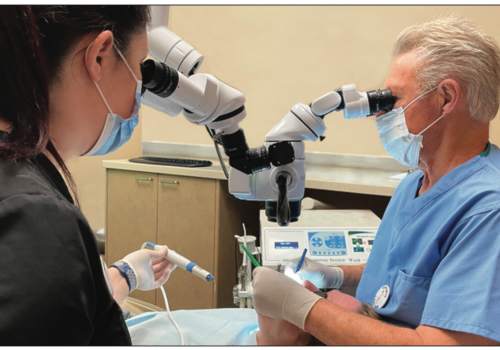
After administering local anesthesia followed by rubber dam isolation, a trapezoidal-shaped endodontic access cavity was established. Upon inspection with a DG-16 endodontic explorer (Hu-Friedy) under an operating microscope (Roslane Meditech), the pulp chamber floor revealed 4 canal openings. The mesiobuccal (MB1), distobuccal, and palatal canal orifices were located in their regular locations at the angles in the floor-wall junction. An additional orifice was located immediately buccal and in line with the orifice of the palatal canal (Figure 2). Further removal of dentinal shelf beginning from the orifice of the mesiobuccal canal and moving toward the orifice of the palatal canal with ultrasonic microendodontic tip (ET 18D tip [Satelec, A Division of ACTEON North America]) clearly unveiled the orifice of the additional canal. Though the orifices of the palatal, additional, and mesiobuccal canal were in the same line, the orifice of the additional canal was far closer in proximity to the palatal orifice rather than to the mesiobuccal orifice. Because of its unusual location, it was difficult for us to assign it an identity. We assumed that the working length radiograph would be beneficial in revealing the identity of the additional canal. Coronal enlargement was done with a NiTi ProTaper SX rotary file (DENTSPLY Tulsa Dental Specialties) to improve the straight-line access. The pulp tissue was extirpated using barbed broaches (DENTSPLY Maillefer). The working length was initially determined with the help of an apex locator (Raypex5 [VDW]) and later was confirmed using radiographs taken at different horizontal angulations (Figure 3). From the radiographs, the orientation of the file in the additional canal was found following the outline of the file present in the mesiobuccal canal. This suggested that the additional canal was more likely to be the MB2 canal, but the identity of the canal still could not be confirmed as the root outlines were not clear.
To confirm this rare and unusual morphology, dental imaging of the tooth with the help of SCT (Sensation 64 [Siemens]) was planned. A closed dressing was given with a sterilized cotton pellet in the pulp chamber with access cavity restored with Cavit (3M ESPE). Informed consent was obtained from the patient, and a multislice SCT scan of the maxilla was performed with a tube voltage 120 kV and a tube current of 390 mA. The involved tooth was focused and the morphology was obtained in axial sections of one-mm thickness. Horizontal slices of the molar were studied at different levels (coronal, middle, and apical third of the roots) to determine the canal morphology. SCT scan images confirmed the presence of 3 roots, namely mesiobuccal, distobuccal, and palatal. SCT scan slices revealed that all the 3 roots were completely fused, except in the apical third, where they were distinct. The apical axial scan image was valuable, as it confirmed that the additional canal was an MB2 canal. Both the mesiobuccal canals were independent throughout with separate canal orifices and apical foramens. In contrast, the contralateral maxillary second molar was asymmetrical, instead of being identical as it should most likely be. It had only one buccal and a palatal root with buccal root having a configuration similar to that of the mesiobuccal root of the contralateral tooth (Figures 4 to 6).
 |
At the second appointment, the patient was asymptomatic, and cleaning and shaping was performed under rubber dam isolation using ProTaper NiTi rotary instruments with a crown-down technique. Irrigation was performed using 3% sodium hypochlorite solution (Cmident [Cmident]) and EDTA (Glyde File Prep [DENTSPLY International]). Master cones were selected by placing cones corresponding to the size of the last finishing file used to the working length and was confirmed radiographically (Figure 7). The canals were dried with absorbent points (ProTaper [DENTSPLY Maillefer]) and single cone obturation was performed using ProTaper gutta-percha (DENTSPLY Maillefer) with AH Plus resin sealer (DENTSPLY Maillefer). The tooth was then restored with a posterior composite resin core (P60 [3M ESPE]) (Figures 8 and 9). The patient remained asymptomatic during follow-up period.
DISCUSSION
In the maxillary molars, the most commonly encountered extra canal is the second mesiobuccal canal. Studies concerning root canal morphology of the maxillary second molar have reported an equal incidence of one or 2 canals in the mesiobuccal root.31-34 In most teeth, the MB2 orifice openings are usually found mesial to an imaginary line between the MB1 and palatal orifices, and commonly, about 2 mm to 3 mm palatal to the MB1 orifice, appearing to be under the mesial marginal ridge. This imaginary line is more appropriately described as an arc with an apogee toward the mesial, following the contours of the mesial surface of the root.34 While as, in our case, the MB2 orifice was located immediately adjacent to the palatal orifice, which is an unusual occurrence.
A thorough review of the literature failed to reveal any previously reported description of maxillary second molars with this type of orifices and canals arrangement, except for a recently reported case of a maxillary first molar with an MB2 orifice that was located very close to the palatal orifice and was presumed to be a second palatal orifice.35 Krasner and Rankow36 proposed definite guidelines, put forth in form of laws to aid practioners to determine the number and position of orifices of root canals of any tooth. According to the laws of orifice location, the orifices of root canals are always located at the junction of the walls and the floor, at the angles in the floor-wall junction, and at the termini of the root developmental fusion lines. In our case, though the detection of all the orifices was through the routine exploration of the floor of the pulp chamber, the position of the MB1, distobuccal, and palatal canal orifices were in justification with all the 3 laws of orifice location. While the position of the MB2 orifice abided the first law of orifice location, its identification was only possible from SCT scan images.
The deviation of MB2 orifice from its usual location may be attributed to the fusion of the roots as seen here. Molar root fusion is one of the most commonly found anomalies in the development of root morphology. Root fusion is found more frequently in maxillary than in mandibular molars. It is more common in the third molars, followed by second molars, and less often in the first molars, in both arches. When fusion occurs, they usually exhibit a bilateral symmetry and have shown a sexual predilection toward females. Fusion can occur in the apical, middle, or cervical one third of the roots or in any combination of 2 or more of these areas. Complete or true root fusions are consistently more common than partial root fusion. Fusion of roots is usually nonspecific. In majority of maxillary molars, fusion of 2 roots is more often observed. In the maxillary second molar, the mesiobuccal root fuses with the palatal roots more often (mesial fusion) (16.4%) than the distobuccal and the mesiobuccal roots (buccal fusion) (11.9%) or the distobuccal and the palatal roots (distal fusion) (7.5%). Likewise, fusion of distobuccal, mesiobuccal, and palatal roots (buccal and mesial fusion) (10.5%) happens more often than the fusion of the mesiobuccal, distobuccal, and palatal roots (buccal and distal fusion) (7.5%) or the mesiobuccal, palatal, and distobuccal roots (mesial and distal fusion) (4.5%). Similarly, fusion of all 3 roots, though incomplete, is reported to occur in 1.5% of cases, while completely fused roots are seen in 6% of cases.37 In our case, all 3 roots were completely fused, except in the apical third, where they were distinct (Figure 6). The fusion of the mesiobuccal and palatal roots resulted in a mesiobuccal root being much broader buccolingually than usual. This probably resulted in deviation of the MB2 orifice closer to palatal canal orifice.
This type of variation is usually difficult to diagnose with periapical radiographs. In such doubtful cases, advanced diagnostic methods such as SCT must be employed. Slowey1 emphasized that root canal morphology was limitless in its variability and that clinicians must be aware that anatomic variations constitute a formidable challenge to endodontic success. The discovery of this variation highlights that the MB2 orifice may be displaced palatally at times, and actually lies far from the MB1 orifice and closer to the palatal orifice.
CLOSING COMMENTS
Locating the number and position of orifices on the floor of the pulp chamber is at times difficult. This case report presents a variation in the location of MB2 canal orifice in the maxillary second molar that dental practitioners do not encounter frequently. The clinician should always be aware that in certain cases, there is always a possibility of such deviation and should not restrict to a limited or standard pattern.
References
- Slowey RR. Radiographic aids in the detection of extra root canals. Oral Surg Oral Med Oral Pathol. 1974;37:762-772.
- Pécora JD, Woelfel JB, Sousa Neto MD, et al. Morphologic study of the maxillary molars. Part II: Internal anatomy. Braz Dent J. 1992;3:53-57.
- Zhu Z, Zhao SL. Maxillary second molar with five root canals: a case report [in Chinese]. Shanghai Kou Qiang Yi Xue. 2011;20:219-221.
- Kottoor J, Hemamalathi S, Sudha R, et al. Maxillary second molar with 5 roots and 5 canals evaluated using cone beam computerized tomography: a case report. Oral Surg Oral Med Oral Pathol Oral Radiol Endod. 2010;109:e162-e165.
- Prashanth MB, Jain P, Patni P. Maxillary right second molar with two palatal root canals. J Conserv Dent. 2010;13:94-96.
- Zhang TT, Qiu W, Ming CX. Maxillary second molar with two palatal root canals: a case report [in Chinese]. Hua Xi Kou Qiang Yi Xue Za Zhi. 2010;28:678-679.
- Singla M, Aggarwal V. C-Shaped palatal canal in maxillary second molar mimicking two palatal canals diagnosed with the aid of spiral computerized tomography. Oral Surg Oral Med Oral Pathol Oral Radiol Endod. 2010;109:e92-e95.
- Zhang QF, Liu GQ, Zhao HJ, et al. Maxillary second molar with two buccal and two lingual root canals: a case report [in Chinese]. Hua Xi Kou Qiang Yi Xue Za Zhi. 2009;27:115-116.
- Qun L, Longxing N, Qing Y, et al. A case of asymmetric maxillary second molar with double palatal roots. Quintessence Int. 2009;40:275-276.
- Ozcan E, Aktan AM, Ari H. A case report: Unusual anatomy of maxillary second molar with 3 mesiobuccal canals. Oral Surg Oral Med Oral Pathol Oral Radiol Endod. 2009;107:e43-e46.
- Holderrieth S, Gernhardt CR. Maxillary molars with morphologic variations of the palatal root canals: a report of four cases. J Endod. 2009;35:1060-1065.
- Kim JR, Choi SB, Park SH. A maxillary second molar with 6 canals: a case report. Quintessence Int. 2008;39:61-64.
- Pasternak Júnior B, Teixeira CS, Silva RG, et al. Treatment of a second maxillary molar with six canals. Aust Endod J. 2007;33:42-45.
- de Almeida-Gomes F, Maniglia-Ferreira C, dos Santos RA. Two palatal root canals in a maxillary second molar. Aust Endod J. 2007;33:82-83.
- Ulusoy OI, Görgül G. Endodontic treatment of a maxillary second molar with 2 palatal roots: a case report. Oral Surg Oral Med Oral Pathol Oral Radiol Endod. 2007;104:e95-e97.
- Shin SJ, Park JW, Lee JK, et al. Unusual root canal anatomy in maxillary second molars: two case reports. Oral Surg Oral Med Oral Pathol Oral Radiol Endod. 2007;104:e61-e65.
- Prakash R, Bhargavi N, Rajan J, et al. MB2 in maxillary second molar. Indian J Dent Res. 2007;18:38-40.
- Jafarzadeh H, Javidi M, Zarei M. Endodontic retreatment of a maxillary second molar with three separate buccal roots. Aust Endod J. 2006;32:129-132.
- Barbizam JV, Ribeiro RG, Tanomaru Filho M. Unusual anatomy of permanent maxillary molars. J Endod. 2004;30:668-671.
- Alani AH. Endodontic treatment of bilaterally occurring 4-rooted maxillary second molars: case report. J Can Dent Assoc. 2003;69:733-735.
- Fava LR, Weinfeld I, Fabri FP, et al. Four second molars with single roots and single canals in the same patient. Int Endod J. 2000;33:138-142.
- Deveaux E. Maxillary second molar with two palatal roots. J Endod. 1999;25:571-573.
- Zmener O, Peirano A. Endodontic therapy in a maxillary second molar with three buccal roots. J Endod. 1998;24:376-377.
- Brenna F, Benanini M, Vescovi P, et al. Therapy of a maxillary second molar with 5 root canals [in Italian]. Attual Dent. 1990;6:16-18, 20.
- Fahid A, Taintor JF. Maxillary second molar with three buccal roots. J Endod. 1988;14:181-183.
- Benenati FW. Maxillary second molar with two palatal canals and a palatogingival groove. J Endod. 1985;11:308-310.
- Fava LR. Endodontic therapy in an abnormal case. Maxillary second molar with four roots [in Portuguese]. Rev Assoc Paul Cir Dent. 1980;34:157-160.
- Malagnino V, Gallottini L, Passariello P. Some unusual clinical cases on root anatomy of permanent maxillary molars. J Endod. 1997;23:127-128.
- Thompson BH. Endodontic therapy of an unusual maxillary second molar. J Endod. 1988;14:143-146.
- Sert S, Bayrl G. Taurodontism in six molars: a case report. J Endod. 2004;30:601-602.
- al Shalabi RM, Omer OE, Glennon J, et al. Root canal anatomy of maxillary first and second permanent molars. Int Endod J. 2000;33:405-414.
- Kulild JC, Peters DD. Incidence and configuration of canal systems in the mesiobuccal root of maxillary first and second molars. J Endod. 1990;16:311-317.
- Imura N, Hata GI, Toda T, et al. Two canals in mesiobuccal roots of maxillary molars. Int Endod J. 1998;31:410-414.
- Stropko JJ. Canal morphology of maxillary molars: clinical observations of canal configurations. J Endod. 1999;25:446-450.
- Chakradhar Raju RV, Sathe N, Morisetty PK, et al. Endodontic management of a maxillary first molar with unusual location of second mesio buccal orifice. J Conserv Dent. 2010;13:162-164.
- Krasner P, Rankow HJ. Anatomy of the pulp-chamber floor. J Endod. 2004;30:5-16.
- Hou GL, Tsai CC. The morphology of root fusion in Chinese adults (I). Grades, types, location and distribution. J Clin Periodontol. 1994;21:260-264.
Dr. Nayak received his bachelor of dental surgery from the Manipal College of Dental Sciences, Manipal University, Mangalore, India, in 1998. He went on to complete his master’s degree in the field of conservative dentistry and endodontics from Rajiv Gandhi University of Health Sciences, Bangalore, India, in 2002. He is presently associated with Kanti Devi Dental College and Hospital, Mathura, India, and does extensive teaching at the undergraduate and postgraduate level in the field of conservative dentistry and endodontics. He can be reached via e-mail at the address gurudutt_nayak@hotmail.com.
Disclosure: Dr. Nayak reports no disclosures.
Dr. Singh received his bachelor of dental surgery from the Dasmesh Institute of Research and Dental Science, Baba Farid University of Health Science, Faridkot, India, in 2008. He is presently perusing his master’s degree in the field of conservative dentistry and endodontics from Kanti Devi Dental College and Hospital, Mathura, India. He can be reached at inderpreet.singh.dr@gmail.com.
Disclosure: Dr. Singh reports no disclosures.